
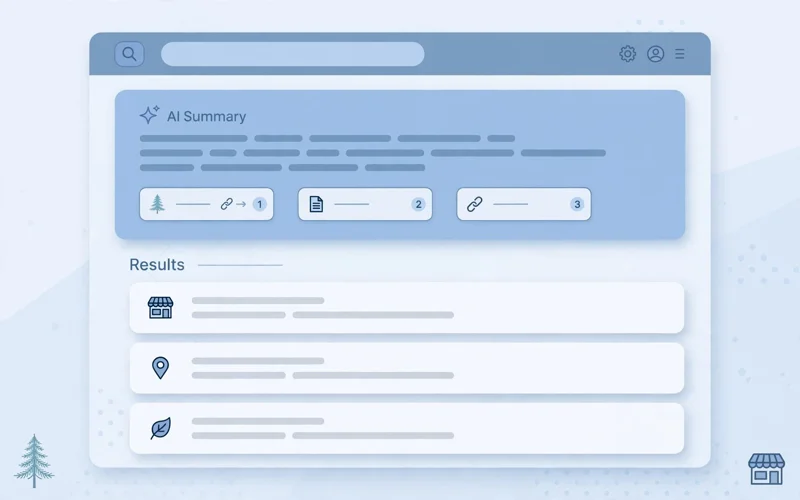
When someone in Oregon searches “best HVAC company in Eugene” or “how much does a roof replacement cost in Bend,” Google increasingly answers with an AI-generated summary at the top of the results — and that summary names and links to a handful of websites. Those businesses didn’t pay for the placement. They earned it by being the sources Google chose to cite.
Getting cited in Google AI Overviews is fast becoming one of the most visible forms of online credibility a local business can have. But most of the advice floating around is either vague or flat-out wrong. This guide sticks to what Google itself has published about how AI Overviews work, adds the practical steps that follow from it, and stays honest about what no one can promise.
How Google chooses what to cite in AI Overviews
AI Overviews appear on queries where they can “add additional benefits beyond what people might already get on Search,” typically complicated questions, and they serve as a jumping-off point for exploring linked sources. The mechanism that matters most is query fan-out: Google issues multiple related searches across subtopics and data sources, then identifies more supporting pages during the process. The result, in Google’s words: AI Overviews display “a wider and more diverse set of helpful links associated with the response than with a classic web search.” An Overview can cite your page even when you don’t hold the #1 classic ranking — a genuine opening for smaller Oregon businesses.
The eligibility bar is refreshingly simple. From Google’s official guide to AI features in Search: to be shown as a supporting link in AI Overviews, a page “must be indexed and eligible to be shown in Google Search with a snippet,” and “there are no additional technical requirements.” There is no separate AI index. AI Overviews are rooted in the same core ranking and quality systems as classic Search — so AI visibility starts with solid, fundamental SEO, not secret tricks.
First, make sure your pages are eligible to be cited
Before worrying about content strategy, confirm the technical gate is open — plenty of businesses fail at one of these four checks:
- Confirm your key pages are indexed. Run your service and location pages through Search Console’s URL Inspection tool. A page that isn’t indexed can’t be cited — full stop.
- Make sure they’re eligible to show a snippet. Check that no
noindex,nosnippet,data-nosnippet, ormax-snippet:0directives are suppressing the content you’d want quoted; these preview controls directly affect how pages appear in AI features. - Confirm crawling is allowed. Your robots.txt — and any CDN or hosting setup in front of it — must let Googlebot through. One stray
Disallowcan take whole sections out of the running. - Give fixes time. After changing indexing or snippet settings, request a recrawl in Search Console. Recrawling can take days to months, so don’t panic if a fix doesn’t register overnight.
If any of this sounds like uncharted territory, it’s exactly the kind of thing our technical SEO service is built to surface.
What Google’s own guidance says to focus on
Google’s AI features documentation reads less like a new playbook and more like a greatest-hits list of SEO fundamentals. The practices it calls worthwhile for AI Overviews and AI Mode:
- Making content easily findable through internal links on your website
- Providing a great page experience — fast, mobile-friendly pages
- Keeping important content available in textual form, not trapped inside images alone
- Supporting text with high-quality images and video where relevant
- Making sure structured data matches the visible text on the page
- Keeping your Business Profile information up to date — this is a big one for local businesses, since AI Overviews lean on business data for local queries
- Verifying your site in Search Console so you can diagnose issues
For an Oregon business, that checklist means very concrete work: a Google Business Profile that’s complete and current (our Google Business Profile checklist for Oregon businesses covers every field), consistent business information across your site and listings, and service pages that load fast on a phone.
One note on structured data: Google removed the FAQ rich result from Search results in May 2026, per its Search Central changelog — so the old tactic of adding FAQ markup to win a bigger result is over. But a visible Q&A section with matching FAQPage markup remains one of the cleanest formats for an AI system to understand and quote accurately, which is why we still use it.
Writing content AI Overviews can actually quote
Eligibility gets you in the door. To actually be the source an Overview cites, your content needs to be quotable — the kind of page a summarizer naturally reaches for:
Lead with direct answers
Open key sections with a one- or two-sentence answer to the exact question a customer is asking, then add detail below. “A roof replacement in Bend typically costs $9,000 to $15,000” is a sentence an AI system can lift cleanly. Three paragraphs of throat-clearing before the answer is not.
Publish things competitors can’t copy
AI Overviews summarize what’s distinctive, not what’s duplicated. First-hand experience, Oregon-specific examples, real numbers from your own jobs, and original photos of your work all give a summarizer something to cite that no competitor’s page can offer.
Use quote-friendly formatting
Short definitional sentences, numbered steps, comparison tables, and clearly labeled statistics are all easy for AI systems to extract without distortion. Dense walls of text and clever-but-vague headings are the opposite.
Keep one topic per page, with consistent naming
Use the same business name, service names, and city references everywhere — your site, your Business Profile, your directory listings. When sources disagree about who you are and where you operate, confidence drops.
For the broader playbook across ChatGPT, Gemini, and Perplexity, see our guide to getting recommended by AI assistants — this article goes deep on Google’s AI Overviews specifically.
What to stop doing — Google says none of it is required
The “no additional technical requirements” line from Google is doing a lot of quiet work. It means you can ignore a whole category of supposed AI-visibility tricks:
- No special schema, AI text file, or markup “gets you into” AI Overviews. Eligibility is indexed plus snippet-eligible, period.
- No rewriting your site “for the AI.” Google points back to the same people-first, helpful content it has always asked for.
- No manufactured mentions. Real mentions from chambers, associations, and local press help as genuine trust signals — buying mentions or links to game citations backfires.
If an agency promises guaranteed placement in AI Overviews, treat it like any other guaranteed-ranking promise: as a red flag. Google says meeting the requirements “does not guarantee crawling, indexing or serving.”
How to measure whether you’re being cited
Until recently, AI visibility was a guessing game. That changed in 2026: Google launched a dedicated generative AI performance report in Search Console — announced in June and rolled out to all websites worldwide by August 31, 2026 — showing how often your pages appear in AI Overviews, AI Mode, and generative features in Discover.
The catch: it’s impressions only — no clicks, no click-through rate, no position, no query-level data. You can see that a page appeared, by page, country, device, and date, but not which question triggered it. A useful visibility signal, not a complete measurement story (see this industry breakdown of the rollout for the details).
So pair the report with your own checks:
- Spot-check your money queries monthly. Search the questions your customers actually ask and note whether an AI Overview appears and who gets cited. Record what you see and track it over time.
- Watch branded search and direct traffic. Being named in AI answers builds familiarity that shows up as people searching for your business by name.
- Monitor referrals in analytics. Citation clicks do happen, and they’ll show up as ordinary search referrals.
And here’s the trade-off to go in with eyes open: independent studies have reported organic click-through rates dropping by roughly half or more on queries where AI Overviews appear — the same industry coverage cites a 61% CTR reduction found in one research study and 58% for top-ranking pages in an Ahrefs analysis. That sounds alarming until you pair it with Google’s own observation: “when people click from search results pages with AI Overviews, these clicks are higher quality (meaning, users are more likely to spend more time on the site).” Fewer clicks, but from people who got a useful answer and still chose you. For a local business, that’s often the better visitor.
Frequently asked questions
Can I pay to be cited in Google AI Overviews?
No. There’s no ad product or paid placement inside the AI-generated text; eligibility is technical and selection is algorithmic. Anyone selling guaranteed placement is overpromising.
Does getting cited replace ranking in classic search?
No — it builds on it. AI Overviews draw from the same index and the same ranking and quality systems. Keep investing in the fundamentals that earn rankings: they’re also what earn citations. Our plain-English guide to generative engine optimization explains how GEO relates to traditional SEO.
Can I opt out of AI Overviews?
Yes, via preview controls (nosnippet, data-nosnippet, max-snippet, or noindex). But those also remove your content from ordinary snippets elsewhere, so opting out is rarely right for a business trying to get found. Allow recrawl time before the change takes effect.
My competitor gets cited and I don’t. Why?
Usually: their key pages are indexed with stronger fundamentals, or their content answers the question more directly. But Overviews also vary by query and over time — check your own eligibility first, improve your content second, and don’t expect every query to name you.
Does Search Console show which questions cited my pages?
Not yet. The generative AI report shows impressions by page, country, device, and date — with no query-level data, no clicks, and no position as of the August 2026 rollout. Google has said more metrics may arrive over time.
The bottom line
Getting cited in Google AI Overviews isn’t a separate discipline from SEO — it’s a reward for doing SEO well. Google’s own documentation says it plainly: be indexed, be eligible to show a snippet, and keep doing the fundamentals — crawlable pages, strong internal links, fast mobile experience, text-first content, accurate structured data, and a current Business Profile. That’s what our local SEO service delivers for Oregon businesses every month. Write content that answers real customer questions directly and distinctively, and you give Google’s systems something worth citing.
Want to know exactly where your business stands today? Get a free SEO audit from AI SEO Lift — delivered within 48 hours — covering your indexing, technical foundation, and AI search visibility, with plain-English next steps you can actually use.
Pingback: Roofing SEO Portland: Rank Higher & Book More Jobs